Skip to content
  • Close
  • Home
  • Events
  • News
  • Donate
  • Contact
  • Who We Are
    • About The Alliance
      • Staff
      • Board of Directors
  • What is Longleaf?
    • The Tree
      • Life Stages
      • The History
      • The Economics
      • The Misconceptions
    • The Ecosystem
      • Built by Fire
      • Habitats
      • Species Diversity
    • Restoration & Management
      • Groundcover Restoration
      • Herbicides
      • Longleaf Regeneration
      • Prescribed Fire
    • Photo Gallery
  • What We Do
    • Restoration Through Partnerships
      • America’s Longleaf
      • Mapping
      • Corporate Sustainability Programs
      • Nurseries
      • Longleaf Enhancement Fund for Seed & Seedling Production
    • Longleaf Assistance
    • Conserving Diverse Forests
      • Rare Species
      • Forests & Water
      • Georgia Sentinel Landscape Prescribed Fire
    • Education & Outreach
      • Longleaf Academy Program
      • Biennial Longleaf Conference
      • Burner Bob®
      • Next Generation
      • The Longleaf Leader
      • The Longleaf Library
      • The Owen Fellowship
  • What You Can Do
    • Support The Alliance
    • Conservation Partners
    • Get Involved
    • Merchandise
    • Subscribe
logo
  • Contact
  • Events
  • Donate
search
newsearch

The Tree

HomeWhat is Longleaf?The TreeThe History

The History

The average American's view of the natural communities of the Southeastern U.S. is that it is comprised mainly of swamps, alligators, and big, old moss-hung cypress trees. On the contrary to this view, when early explorers visited the southeastern region they saw "a vast forest of the most stately pine trees that can be imagined, planted by nature at a moderate distance...enameled with a variety of flowering shrubs." Fire defined where the longleaf pine forest was found and fostered an ecosystem diverse in plants and animals.

Longleaf pine's domain was vast. By all accounts, the longleaf pine forest dominated the southern landscape. Starting in southeast Virginia, the longleaf pine forest stretched southward through nine states eventually stopping in east Texas (over 140,000 square miles).

For countless generations, cultures were both transformed by and helped to transform the longleaf piney woods. However, starting about 150 years ago, over-exploitation of the longleaf pine forest accelerated tremendously and the face of the southern landscape changed radically.
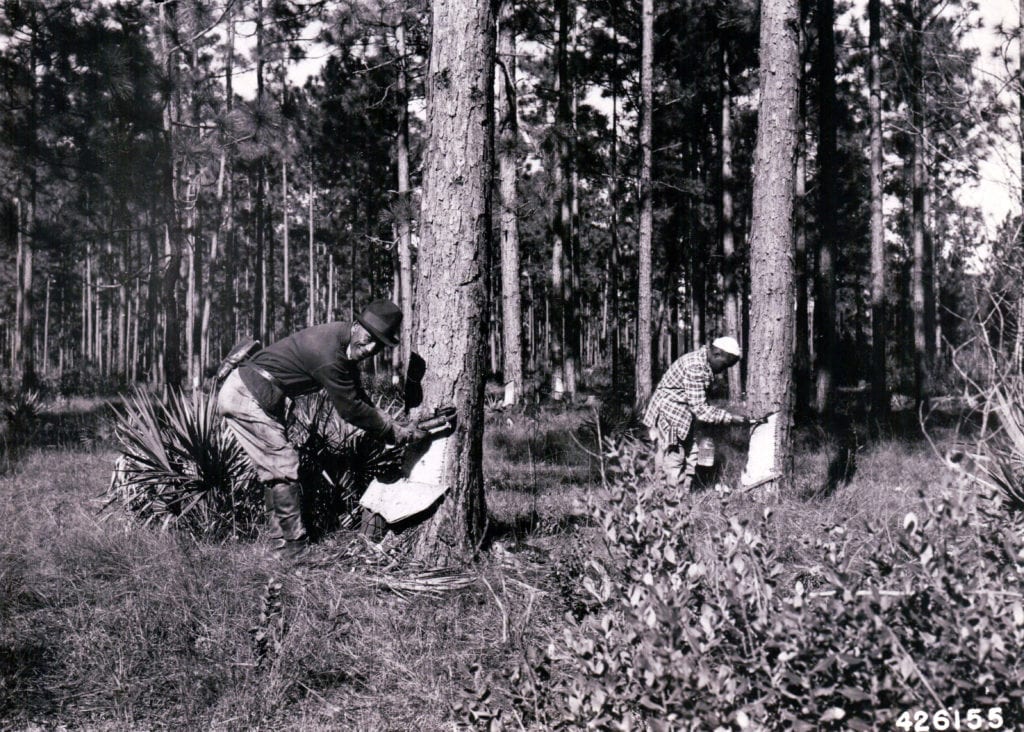
Chemical stimulation to gum yield - chipper and acid application at Olustee, Florida. October, 1942. Photo by C. S. Shopmeyer, U.S. Forest Service.
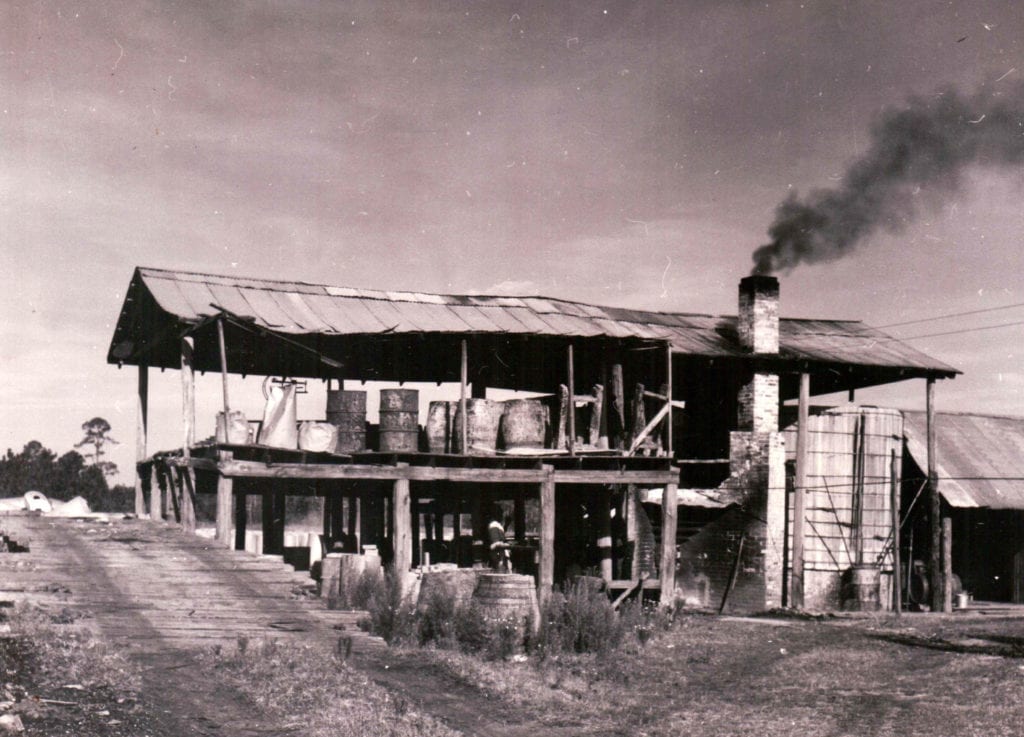
Distilleries produced refined turpentine and rosin from crude pine resin. Florida. Photo by Panshin, et al. U.S. Forest Service.
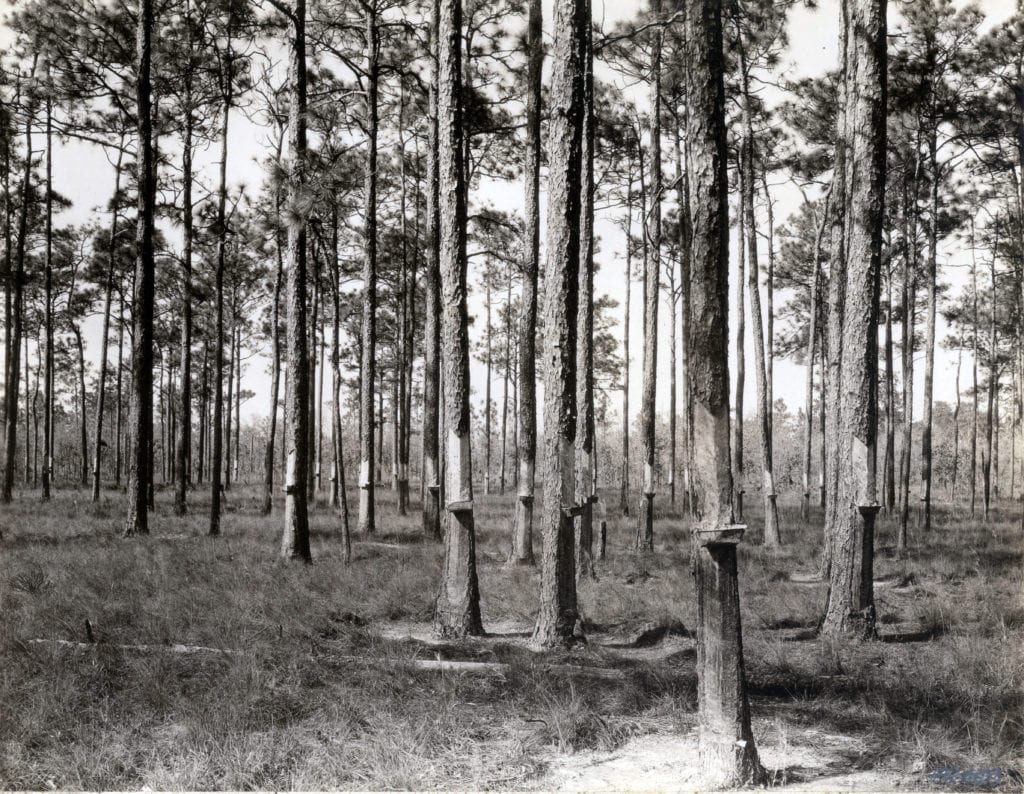
Naval stores orchard using the cup and gutter technique to collect resin—a less intrusive method compared to the early practice of "boxing." Photo by Panshin, et al. U.S. Forest Service.
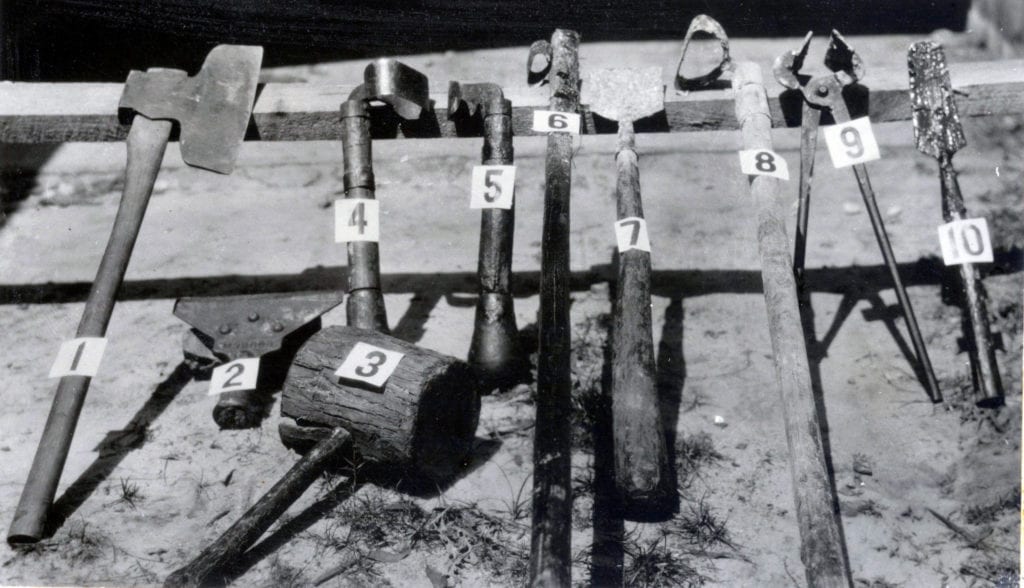
Turpentine tools: 1. Broad axe; 2. Gutter chisel or Pringle axe; 3. Maul; 4. Hogal; 5. Hack; 6. Puller; 7. Push down scraper; 8. Pull down scraper; 9. Apron and gutter puller; 10. Dip iron. Photo by U.S. Forest Service.

BROWSE THIS SECTION

  • The Tree
    • Life Stages
    • The Economics
    • The History
    • The Misconceptions
  • The Ecosystem
    • Built by Fire
    • Habitats
    • Species Diversity
  • Restoration & Management
    • Groundcover Restoration
    • Herbicides
    • Longleaf Regeneration
    • Prescribed Fire
  • Photo Gallery

From our feed

You’re a Mighty Pine Friend! On Valentine’s Day, You’re a Mighty Pine Friend! On Valentine’s Day, as many of us set aside time to express heartfelt gratitude, we would like to take this opportunity to personally thank you for your contributions to The Longleaf Alliance and the longleaf pine ecosystem. On behalf of our dedicated staff and Board of Directors, we are deeply grateful that you’ve chosen to conserve, restore, and care about the natural world. The Alliance quite literally couldn’t operate without its unbe-LEAF-able supporters. 📷 Longleaf Alliance Board of Directors and Executive Staff at Brosnan Forest, a private 14,400-acre preserve near Charleston, SC. [Carol Denhof]#WeLoveOurMembers #WLOMW2026 #WLOM2026 #ForTheLoveOfLongleaf #WeHeartLongleaf #LongleafLove #RestoreLongleaf #longleafalliance #longleafpineecosystem #longleaf #longleafpine #longleafpines #ThankYouNorfolkSouthern
#WeLoveOurMembers Trivia Challenge – Burner Bob®, #WeLoveOurMembers Trivia Challenge – Burner Bob®, our favorite prescribed fire advocate, is a Bobwhite Quail. While Bob lives in the longleaf pine forest, his quail family can also be found in other habitats including grasslands, scrub, and old fields.Which map represents the species range of Northern Bobwhite Quail?Comment with your guesses to enter the "We Love Our Members" ✨GIVEAWAY✨ Today is the last chance to win one of 3 prizes!#BirdsOfThePine #WLOM2026 #WLOMW2026 #BeOurValentine #ForTheLoveOfLongleaf #WeHeartLongleaf #LongleafLove #RestoreLongleaf #longleafalliance #longleafpineecosystem #longleaf #longleafpine #longleafpines #Pinuspalustris
We 💖 Our Members Spotlight 🌱 “I’d like to recogni We 💖 Our Members Spotlight 🌱“I’d like to recognize Ernst Conservation Seeds for their steady and impactful 20-year conservation partnership with The Longleaf Alliance. Ernst’s dedicated staff provide native plant materials that are so important for restoration, reclamation, and habitat enhancement. They identify, collect, and propagate new species and ecotypes that meet clients’ needs, from eastern Canada to the southeastern United States. They are undoubtedly making a direct impact on the restoration of our beloved longleaf pine ecosystem. It is an honor to work closely with dedicated partners like Ernst.” - Carol Denhof, TLA President@ernstseeds  #WLOM2026 #WLOMW2026 #BeOurValentine #ForTheLoveOfLongleaf #WeHeartLongleaf #LongleafLove #RestoreLongleaf #longleafalliance #longleafpineecosystem #longleaf #longleafpine #longleafpines #Pinuspalustris
Patrick Elliott’s stunning longleaf ecosystem illu Patrick Elliott’s stunning longleaf ecosystem illustration is bursting with biodiversity! His artwork features 164 different species of plants and animals found across longleaf pine forests in Florida, Georgia, and Alabama. Every inch of the piece highlights just how rich and vibrant the longleaf ecosystem truly is. Explore the species key at https://longleafalliance.org/wp-content/uploads/2026/02/Ecosystem-Print-Teacher-Set.pdfThanks for playing along with "We Love Our Members" Trivia. ✨GIVEAWAY✨ winners will be announced next week!#WLOM2026 Trivia answer #EcosystemArt #Biodiversity #WeLoveOurMembers #WLOMW2026 #BeOurValentine #ForTheLoveOfLongleaf #WeHeartLongleaf #LongleafLove #RestoreLongleaf #longleafalliance #longleafpineecosystem #longleaf #longleafpine #longleafpines #Pinuspalustris

Conservation partners

Manulife

Manulife

PRT

PRT

RMS

RMS

Norfolk Southern

Norfolk Southern

Bartlett

Bartlett

advantage

advantage

Blanton

Blanton

Drax

Drax

Enviva

Enviva

Graphic Packaging International

Graphic Packaging International

Kronospan

Kronospan

  • Home
  • Who We Are
  • What is Longleaf?
  • What We Do
  • What You Can Do
  • The Longleaf Library
  • Photo Gallery
  • Merchandise
  • Events
  • News
  • Donate
  • Contact
  • Subscribe
footer-logo

12130 Dixon Center Road
Andalusia, Alabama 36420
Phone: 334.427.1029


©2025 The Longleaf Alliance
HLJ Creative Web Design