Skip to content
  • Close
  • Home
  • Events
  • News
  • Donate
  • Contact
  • Who We Are
    • About The Alliance
      • Staff
      • Board of Directors
  • What is Longleaf?
    • The Tree
      • Life Stages
      • The History
      • The Economics
      • The Misconceptions
    • The Ecosystem
      • Built by Fire
      • Habitats
      • Species Diversity
    • Restoration & Management
      • Groundcover Restoration
      • Herbicides
      • Longleaf Regeneration
      • Prescribed Fire
    • Photo Gallery
  • What We Do
    • Restoration Through Partnerships
      • America’s Longleaf
      • Mapping
      • Corporate Sustainability Programs
      • Nurseries
      • Longleaf Enhancement Fund
    • Longleaf Assistance
      • TLA Planting Fund
    • Conserving Diverse Forests
      • Rare Species
      • Forests & Water
    • Education & Outreach
      • Longleaf Academy Program
      • Biennial Longleaf Conference
      • Burner Bob®
      • Next Generation
      • The Longleaf Leader
      • The Longleaf Library
      • The Owen Fellowship
  • What You Can Do
    • Support The Alliance
    • Conservation Partners
    • Get Involved
    • Merchandise
    • Subscribe
logo
  • Contact
  • Events
  • Donate
search
newsearch

Education & Outreach

HomeWhat We DoEducation & OutreachThe Longleaf Leader

The Longleaf Leader

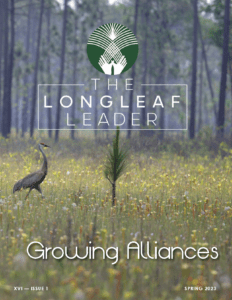
The Longleaf Leader is an official publication of The Longleaf Alliance, produced and distributed quarterly to assist our mission to educate and assist landowners, natural resource professionals, partners, and other longleaf enthusiasts on relevant longleaf pine topics. Members of The Longleaf Alliance receive our quarterly magazine The Longleaf Leader delivered directly to their mailbox or inbox. 
To receive your gift subscription, become a member today.

Longleaf-Leader-Spring-2023

Publication Contributions

Please follow The Longleaf Leader Guidelines to submit an article, photo, or event for inclusion.

Advertising information is available in the Media Kit. Contact Sarah Crate with questions.

Submission Guidelines
Media Kit

Past Issues

We make our past issues available online for the entire longleaf community following the mailing of the newest issue. If you would like to receive the most up-to-date information, please consider supporting The Longleaf Alliance.

2026

Winter

2025

Winter

Spring

Summer

Fall

2024

Winter

Spring

Summer

Fall

2023

Winter

Spring

Summer

Fall

2022

Winter

Spring

Summer

Fall

2021

Winter

Spring

Summer

Fall

2020

Winter

Spring

Summer

Fall

2019

Winter

Spring

Summer

Fall

2018

Winter

Spring

Summer

Fall

2017

Winter

Spring

Summer

Fall

2016

Winter

Spring

Summer

Fall

2015

Winter

Spring

Summer

Fall

2014

Spring

Summer

Fall

BROWSE THIS SECTION

  • Restoration Through Partnerships
    • America’s Longleaf
    • Mapping
    • Nurseries
    • Longleaf Enhancement Fund for Seed & Seedling Production
    • Corporate Sustainability Programs
  • Longleaf Assistance
  • Conserving Diverse Forests
    • Rare Species
    • Forests & Water
    • Georgia Sentinel Landscape Prescribed Fire Program
  • Education & Outreach
    • Longleaf Academy Program
    • Biennial Longleaf Conference
    • Burner Bob®
    • Next Generation
    • The Longleaf Leader
    • The Longleaf Library
    • The Owen Fellowship

From our feed

Hot off the press! The latest USDA Forest Service Hot off the press! The latest USDA Forest Service Longleaf Pine Cone Report shows a promising outlook for 2026 – the best since 2017! Based on green cone counts this spring, the predicted regional longleaf cone crop for this fall is GOOD with an average of 53.9 cones per tree, an encouraging indicator for both natural regeneration this fall and future nursery seedling production. While there is hope on the horizon, it is important to remember that cone  production varies by site and weather risks remain. Annual monitoring by the UDSA Forest Service is crucial for continuing longleaf restoration efforts. Having an idea of upcoming cone crops helps longleaf growers plan for seed collection and informs land managers' upcoming activities, like prescribed burning or selective harvesting, to promote recruitment. In 2025, the poor predicted cone crop allowed partners to rally together to ensure sufficient cone collection was possible at a time when longleaf seed inventory was nearly exhausted. The full report is linked in our bio.[Photo by USDA Forest Service]
Longleaf is one of the most biologically diverse l Longleaf is one of the most biologically diverse landscapes in North America. Longleaf pine ecosystems and associated habitats support a variety of species of plants and animals, some who are endangered, endemic, or rare. Just looking at groundcover plants alone, over 100 species may reside in an area smaller than a quarter acre. The longleaf landscape is essential for sustaining keystone species and building resilience.On International Day of Biological Diversity, we encourage you to “Act Locally for Global Impact” by sharing your plant, animal, & fungi observations on iNaturalist — a worldwide dataset that can help protect species and places. As you contribute, remember that rare or sensitive species locations should be shared only with trusted entities to help safeguard them from being disturbed.  📷: Randy Tate, Brady Beck, Samantha Dillon, Benjamin Genter, Julianne Jones, Mary Keim, Jacob Barrett, Carol Denhof, Erin Cork, Kameron Burgess, Jay McClain, Ad Platt, Casey White, Lisaschleicher, Vernon Compton, Crystal Cockman, Skip Pudney, Sarah Crate, Idburek, Ashlynn Moretti, and other TLA staff members#biodiversity #longleaf #diversity #longleafecosystems #InternationalDayForBiologicalDiversity
There is still time to register for the upcoming L There is still time to register for the upcoming Learn & Burn Field Day in Richton, Mississippi on May 28th! Secure your FREE spot at https://longleaf.info/Learn2BurnMS (link in bio)
Why are bees so vital as pollinators? Unlike most Why are bees so vital as pollinators? Unlike most other insects that visit flowers, bees actively collect pollen to carry back to their nests as food for their young. These nests aren't always in colonies like the well-known (non-native) honey bee. More than 90% of the ~3,600 native bees species in North America are solitary. #WorldBeeDay #Pollinators #NativeSpecies📷Brady Beck

Conservation partners

Manulife

Manulife

PRT

PRT

RMS

RMS

Norfolk Southern

Norfolk Southern

Bartlett

Bartlett

advantage

advantage

Blanton

Blanton

Drax

Drax

Enviva

Enviva

Graphic Packaging International

Graphic Packaging International

Kronospan

Kronospan

  • Home
  • Who We Are
  • What is Longleaf?
  • What We Do
  • What You Can Do
  • The Longleaf Library
  • Photo Gallery
  • Merchandise
  • Events
  • News
  • Donate
  • Contact
  • Subscribe
footer-logo

12130 Dixon Center Road
Andalusia, Alabama 36420
Phone: 334.427.1029


©2025 The Longleaf Alliance
HLJ Creative Web Design