Skip to content
  • Close
  • Home
  • Events
  • News
  • Donate
  • Contact
  • Who We Are
    • About The Alliance
      • Staff
      • Board of Directors
  • What is Longleaf?
    • The Tree
      • Life Stages
      • The History
      • The Economics
      • The Misconceptions
    • The Ecosystem
      • Built by Fire
      • Habitats
      • Species Diversity
    • Restoration & Management
      • Groundcover Restoration
      • Herbicides
      • Longleaf Regeneration
      • Prescribed Fire
    • Photo Gallery
  • What We Do
    • Restoration Through Partnerships
      • America’s Longleaf
      • Mapping
      • Corporate Sustainability Programs
      • Nurseries
    • Longleaf Assistance
      • TLA Planting Fund
    • Conserving Diverse Forests
      • Rare Species
      • Forests & Water
    • Education & Outreach
      • Longleaf Academy Program
      • Biennial Longleaf Conference
      • Burner Bob®
      • Next Generation
      • The Longleaf Leader
      • The Longleaf Library
      • The Owen Fellowship
  • What You Can Do
    • Support The Alliance
    • Conservation Partners
    • Get Involved
    • Merchandise
    • Subscribe
logo
  • Contact
  • Events
  • Donate
search
newsearch

Education & Outreach

HomeWhat We DoEducation & OutreachNext Generation

Next Generation

Children are often more knowledgeable about tropical rainforests and other distant habitats than those in their own backyards – even for an ecosystem like longleaf pine, which is as rich in plants and animals and equally in peril.

The longleaf pine ecosystem presents an opportunity to study important biological concepts, cultural history, and modern conservation issues. Environmental education is a powerful tool we can use to grow a love for longleaf across the Southeast.

Learning with Longleaf

The Longleaf Alliance’s 119-page educational series, Learning with Longleaf, includes 21 lessons and 2 extension activities addressing key ecological concepts:
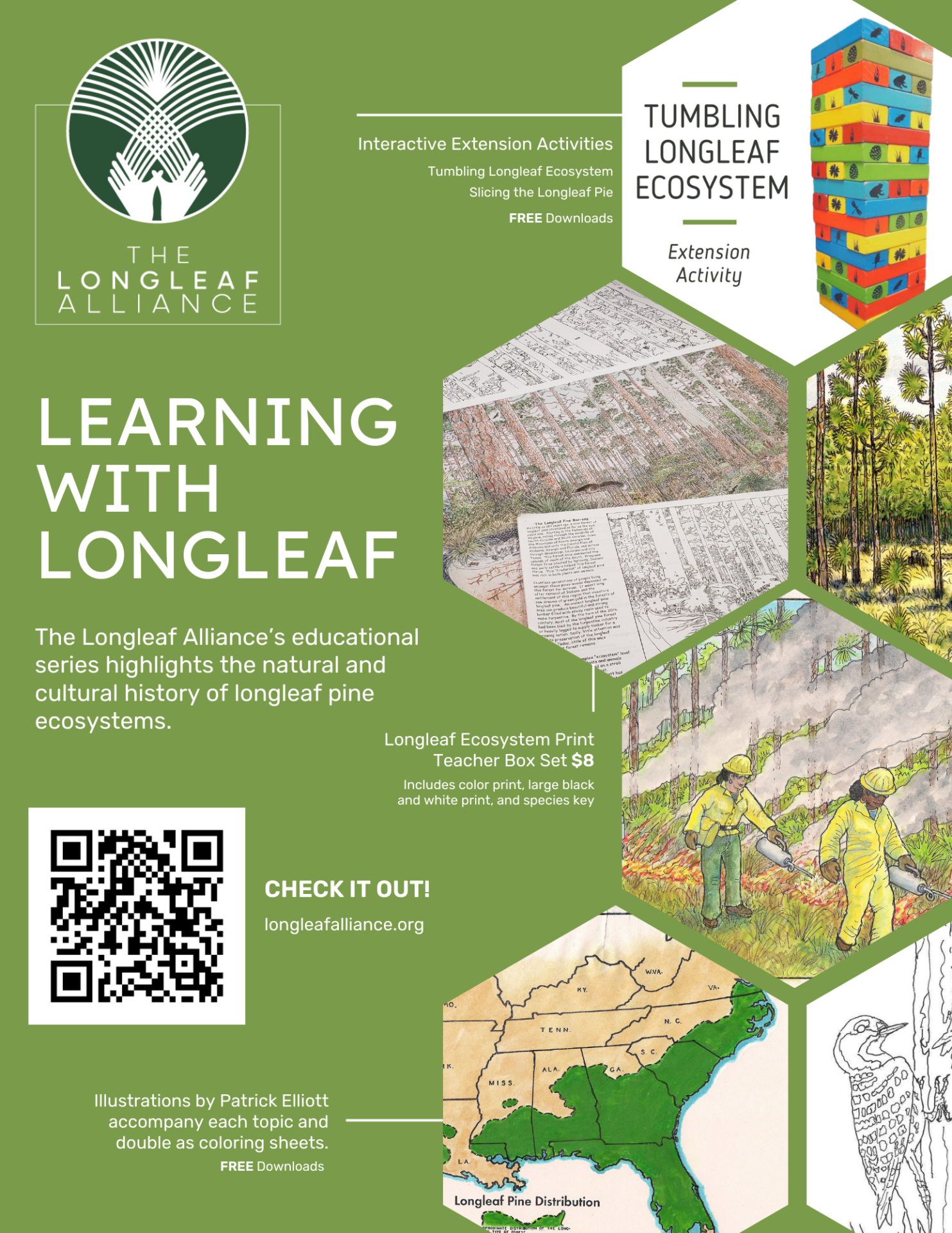
Learning with Longleaf Flyer
  • LONGLEAF PINE FORESTS – The Ecosystem
  • WHO LIVES IN THE FOREST? – Diversity & Interrelationships
  • FIRE IN THE FOREST – Ecological Disturbance
  • HUMAN INFLUENCES – Patterns of Change

Each lesson includes concise messaging for students, background information for teachers, and keyword glossary.

Patrick Elliott's illustrations accompany each topic, with black-and-white printable coloring sheets.

Longleaf Lessons

More educational resources from The Longleaf Alliance:

Burner Bob® - Longleaf pine's prescribed fire mascot is a Bobwhite Quail who shares his message in videos and coloring books.

Longleaf Ecosystem Print - This large-scale, ecosystem level drawing, illustrated by Patrick Elliott, depicts 100+ plants and animals and includes a black and white coded key. Available for purchase.

Tumbling Longleaf Ecosystem - an oversized Jenga®-like activity with color-coded blocks representing components of the longleaf ecosystem to interactively demonstrate the role of fire.

Longleaf children's books:

Kingdom of Longleaf by Frances Kwiatkowski

Longleaf by Roger Reid

Longneedle by Ann Runyon

The Story of Pinus Palustris by Margarate Shearin Cumberland

BROWSE THIS SECTION

  • Restoration Through Partnerships
    • America’s Longleaf
    • Mapping
    • Nurseries
    • Longleaf Enhancement Fund for Seed & Seedling Production
    • Corporate Sustainability Programs
  • Longleaf Assistance
  • Conserving Diverse Forests
    • Rare Species
    • Forests & Water
    • Georgia Sentinel Landscape Prescribed Fire Program
  • Education & Outreach
    • Longleaf Academy Program
    • Biennial Longleaf Conference
    • Burner Bob®
    • Next Generation
    • The Longleaf Leader
    • The Longleaf Library
    • The Owen Fellowship

From our feed

The Longleaf Alliance is hiring! We're looking f The Longleaf Alliance is hiring! We're looking for a Longleaf Forester and two Ecosystem Support Team members to join our staff in NW Florida and South Alabama, home to the largest remaining concentration of old-growth longleaf pine, offering a chance to work in one of the most ecologically significant longleaf landscapes in the Southeast.Details at longleafalliance.org > get-involved (link in bio)📷 The Ecosystem Support Team carries out a wide range of conservation activities, including installing artificial cavities to increase nesting opportunities for Red-cockaded Woodpeckers. The team supports partners in the Gulf Coastal Plain Ecosystem Partnership in implementing a variety of ecosystem management projects – prescribed burning, invasive species control, mechanical treatments, ecological monitoring, rare species recovery, and more. [Alan Patterson, EST member, places a new cavity insert in a pine tree. Photo by Michael Hubbard.]
Carnivorous pitcherplants don’t just trap their di Carnivorous pitcherplants don’t just trap their dinner — they also host a surprising array of wildlife. It’s not uncommon to find a treefrog tucked into a long, tubular pitcher, using it as shelter while waiting for insects drawn in by the plant’s nectar. In return, the frogs leave behind nitrogen-rich “deposits” that the plant desperately needs to thrive in nutrient-poor soils.📷Pinewoods treefrog perches on top a yellow pitcherplant [Julianne Jones]#WorldCarnivorousPlantDay #AmphibianWeek
Wetlands are important functional communities with Wetlands are important functional communities within the longleaf landscape, providing critical water storage and filtering services and serving as high-quality habitat for wildlife and native plants.The Coastal Plain alone has over a half million bays and isolated wetlands which provide essential breeding habitat for amphibians. Because amphibians rely on clean water, they’re powerful indicators of ecosystem health.It’s no coincidence that we celebrate #AmphibianWeek during American Wetlands Month! Photos by Julianne Jones, Ashlynn Moretti, and Rob Tiffin.
Amphibians are some of the coolest creatures on th Amphibians are some of the coolest creatures on the planet, and this Amphibian Week we’re celebrating them all! 🐸 Anura – frogs & toads 🦎 Urodela (or Caudata) – salamanders & newts 🪱 Gymnophiona – caecilians, legless and often underground (but not native to the U.S.) 🆚 Amphibian or Reptile?While both are cold‑blooded, amphibians have moist, permeable skin, undergo metamorphosis (full or partial), and often lay eggs in wet areas. Reptiles, on the other hand, have dry, scaly skin, typically lay eggs on land, and include crocodilians, turtles, lizards/snakes, and tuataras (found only in New Zealand)🐢🐍.Photos by Julianne Jones and Ashlynn Moretti; Illustrations by Ashlynn Moretti#AmphibianWeek #amphibians #frog #salamander

Conservation partners

Manulife

Manulife

PRT

PRT

RMS

RMS

Norfolk Southern

Norfolk Southern

Bartlett

Bartlett

advantage

advantage

Blanton

Blanton

Drax

Drax

Enviva

Enviva

Graphic Packaging International

Graphic Packaging International

Kronospan

Kronospan

  • Home
  • Who We Are
  • What is Longleaf?
  • What We Do
  • What You Can Do
  • The Longleaf Library
  • Photo Gallery
  • Merchandise
  • Events
  • News
  • Donate
  • Contact
  • Subscribe
footer-logo

12130 Dixon Center Road
Andalusia, Alabama 36420
Phone: 334.427.1029


©2025 The Longleaf Alliance
HLJ Creative Web Design